Game fish · sunfish family
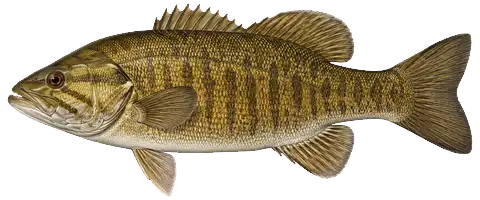
Smallmouth bass
Micropterus dolomieu · also called bronzeback, smallie
- Typical size
- 12–15 in and 1–2 lb
- Spawns
- May and early June, at 55–65°F
- Nests
- On gravel or hard bottom, 2–20 ft deep
- Favors
- Rocky, gravel-bottomed streams with current
- Indiana record
- 8 lb 3.6 oz — Monroe Lake, Monroe County, 2024
Where smallmouth bass have been recorded
12 of the 111 Indiana lakes on this site with fish records list smallmouth bass, across 6 counties. Tap a dot to open that lake’s depth map.
Recorded here Other lakes with fish records
How we know
- 12lakes where a DNR fisheries survey caught them
A lake can appear in more than one line. A lake that isn’t listed may still have them: records exist only where someone caught, netted or stocked them.
Inland lakes on this list run from 38 to 3,508 acres (median 163) and from 8 to 90 ft deep (median 66 ft).
How many turn up in DNR surveys
Indiana DNR crews survey lakes the same way everywhere: timed night electrofishing along the shore, plus gill and trap nets set overnight. The standard method makes lakes comparable. These are the DNR’s own sampling rates from its community surveys, 2008–2025 — a measure of how many fish a lake holds, not how many an angler will catch.
- Found in
- 12 of 105 lakes surveyed this way
- Typical rate
- 3.2 per hour where found
- Highest
- 15 per hour
- Method
- fish per hour of night electrofishing
“Typical” is the median across the lakes where the survey caught at least one. Nets and electrofishing catch different fish: by the other method it turned up in 6 lakes at a typical 0.50 per net lift. A single survey is a snapshot of one season.
Highest survey rates on this site
- Lake Maxinkuckee, Marshall 2020 15
- Westler Lake, LaGrange 2022 14
- Crooked Lake, Steuben 2016 6.0
- Oliver Lake, LaGrange 2019 6.0
- Pretty Lake, LaGrange 2018 4.0
- Wall Lake, LaGrange 2017 4.0
- Lake Wawasee, Kosciusko 2008–2022 2.3
- Cypress Lake, Jackson 2019 2.0
- Myers Lake, Marshall 2018 2.0
- Olin Lake, LaGrange 2021 2.0
Fish per hour of night electrofishing, with survey years. Survey effort and season differ between lakes.
Often found with
Share of these lakes that also list each fish.
How to recognize it
Dark vertical bars on a brown or bronze body, and a jaw that reaches the eye but not past its rear edge. Young smallmouth have orange in the center of the tail.
Don’t confuse it with
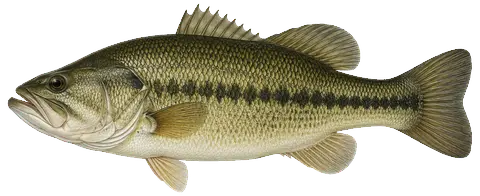
Up close
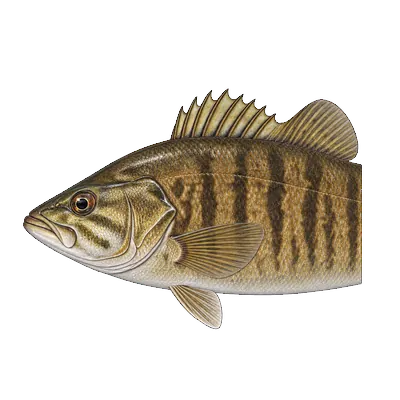
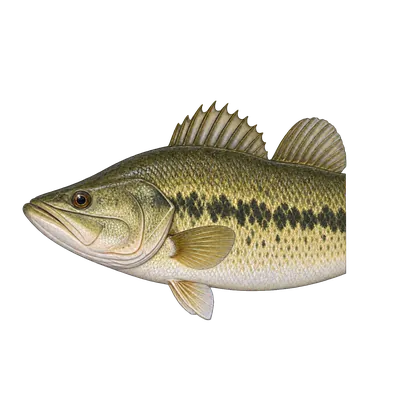
AI-generated close-ups, not photographs, drawn from the cited descriptions. They show what to look for; they are not a substitute for an expert identification (provenance).
Life in an Indiana lake
Smallmouth are fish of gravel- and rock-bottomed streams with current; in lakes they favor steep drop-offs and rocky shores.
The male builds a nest on gravel or hard bottom and guards the eggs and fry for a short time; the young feed on zooplankton and midge larvae.
Source: the sources below.
Rules and eating
Check the rules before you keep fish. Each lake page shows the regulations that apply there, and the Indiana Fishing Guide is the official source. Before eating fish from a particular lake, check the Indiana Fish Consumption Advisory.
All 12 lakes with smallmouth bass
Show every lake, by county
Jackson County 1
Kosciusko County 1
LaGrange County 6
Cedar Lake, Olin Lake, Oliver Lake, Pretty Lake, Wall Lake, Westler Lake
Lake County 1
Marshall County 2
Steuben County 1
Sources
- Indiana DNR: Fishes of Indiana list (native and introduced species)
- Ohio DNR: Smallmouth bass
- Indiana DNR fish surveys (Indiana Data Hub) — lake records and survey catch rates
- Indiana DNR record fish list (angler names are not reproduced here)