Panfish · sunfish family
Crappie (black and white)
Pomoxis nigromaculatus (black) · Pomoxis annularis (white) · also called speck, papermouth, strawberry bass
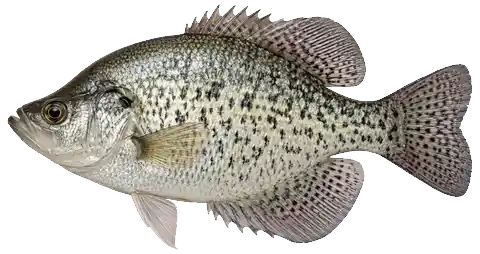
- Two species
- Black and white crappie, managed together
- Spawns
- Late April and May, near 55°F, in 3–10 ft of water
- Eats
- Mostly small fish; also insects, larvae, worms and crayfish
- Found near
- Sunken logs, standing timber, brush piles and docks
- Indiana record
- 4 lb 11 oz — Private Lake, Jennings County, 1994
Where crappie have been recorded
89 of the 111 Indiana lakes on this site with fish records list crappie, across 33 counties. Tap a dot to open that lake’s depth map.
Recorded here Other lakes with fish records
How we know
- 89lakes where a DNR fisheries survey caught them
A lake can appear in more than one line. A lake that isn’t listed may still have them: records exist only where someone caught, netted or stocked them.
Inland lakes on this list run from 7 to 3,508 acres (median 92) and from 6 to 90 ft deep (median 30 ft).
How many turn up in DNR surveys
Indiana DNR crews survey lakes the same way everywhere: timed night electrofishing along the shore, plus gill and trap nets set overnight. The standard method makes lakes comparable. These are the DNR’s own sampling rates from its community surveys, 2008–2025 — a measure of how many fish a lake holds, not how many an angler will catch.
- Found in
- 82 of 100 lakes surveyed this way
- Typical rate
- 1.8 per net lift where found
- Highest
- 67.2 per net lift
- Method
- fish per net lift (gill and trap nets)
“Typical” is the median across the lakes where the survey caught at least one. Nets and electrofishing catch different fish: by the other method it turned up in 41 lakes at a typical 2.4 per hour of electrofishing. A single survey is a snapshot of one season.
Highest survey rates on this site
- Mollenkramer, Ripley 2022 67.2
- Lake Salinda, Washington 2013–2025 54.5
- Cedar Lake, DeKalb 2019 37.2
- Brush Creek Reservoir, Jennings 2018 33.5
- Huntingburg Lake, Dubois 2012–2021 23.8
- Cedarville Reservoir, Allen 2017–2025 14.9
- Ferdinand State Forest Lake, Dubois 2021 13.0
- Little Chapman Lake, Kosciusko 2018 10.0
- Martindale, Wayne 2018–2025 9.1
- Kokomo Reservoir, Howard 2019 7.2
Fish per net lift (gill and trap nets), with survey years. Survey effort and season differ between lakes.
Often found with
Share of these lakes that also list each fish.
How to recognize it
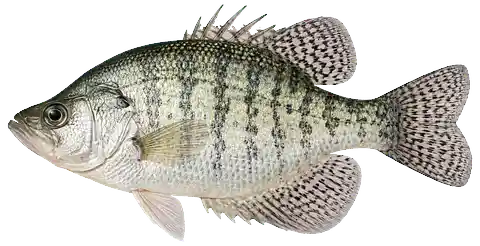
Count the dorsal spines: black crappie have seven or eight, white crappie five or six. Black crappie are mottled with dark blotches that don't form bars; white crappie carry 5–10 vertical bars and a slightly longer body. Indiana manages the two together, so this page covers both.
Don’t confuse it with
Up close
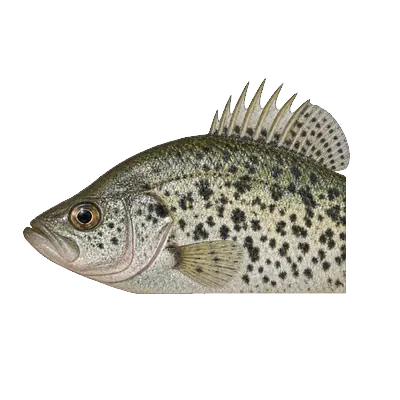
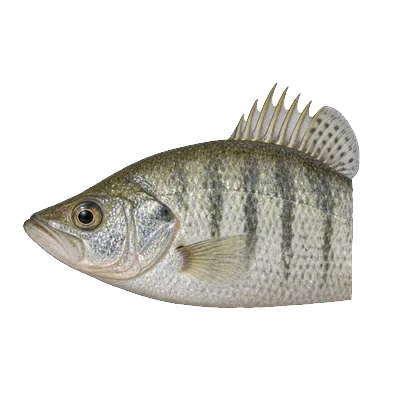
AI-generated close-ups, not photographs, drawn from the cited descriptions. They show what to look for; they are not a substitute for an expert identification (provenance).
Life in an Indiana lake
Crappie live in many Indiana streams, ponds and lakes. They move shallow in spring and fall, when they are easiest to find.
The male fans a nest with his tail in 3–10 ft of water, and females lay in one or more nests; a single nest can hold up to 20,000 eggs. Most Indiana lakes have no crappie size limit, because on most lakes one would leave more small fish competing for the same food.
Source: the sources below.
Rules and eating
Check the rules before you keep fish. Each lake page shows the regulations that apply there, and the Indiana Fishing Guide is the official source. Before eating fish from a particular lake, check the Indiana Fish Consumption Advisory.
All 89 lakes with crappie
Show every lake, by county
Allen County 1
Brown County 2
Clark County 2
DeKalb County 1
Dubois County 3
Beaver Dam Lake, Ferdinand State Forest Lake, Huntingburg Lake
Fulton County 3
Harrison County 1
Henry County 2
Howard County 1
Jackson County 2
Jennings County 1
Kosciusko County 8
Big Chapman Lake, Dewart Lake, Hoffman Lake, James Lake, Lake Wawasee, Little Chapman Lake, Pike Lake, Shock Lake
LaGrange County 13
Appleman Lake, Emma Lake, Eve Lake, Fish Lake, Hackleburg Lake, Lake of the Woods, Messick Lake, North Twin Lake, Oliver Lake, Royer Lake, Wall Lake, Westler Lake, Witmer Lake
LaPorte County 2
Lake County 2
Marshall County 4
Monroe County 1
Newton County 1
Noble County 9
Baugher Lake, Bear Lake, Bixler Lake, Diamond Lake, Gordy Lake, Little Long Lake, Lower Long Lake, Rivir Lake, Williams Lake
Parke County 1
Perry County 3
Pike County 3
Porter County 1
Ripley County 1
Spencer County 1
St. Joseph County 4
Steuben County 3
Sullivan County 2
Vigo County 3
Warrick County 3
Washington County 2
Wayne County 1
Whitley County 2
Sources
- Indiana DNR: Fishes of Indiana list (native and introduced species)
- Indiana DNR: Crappie fishing
- Ohio DNR: Black crappie
- Ohio DNR: White crappie
- Indiana DNR fish surveys (Indiana Data Hub) — lake records and survey catch rates
- Indiana DNR record fish list (angler names are not reproduced here)