Pike family
Redfin (grass) pickerel
Esox americanus · also called grass pickerel, mud pickerel
Indiana DNR lists this fish as “Redfin (Grass) Pickerel”, Esox americanus. The species has two forms: the redfin of Atlantic-coast rivers, and the grass pickerel of the Great Lakes and Mississippi basins. Indiana lies in the grass pickerel's range, so Indiana's fish is usually that form.
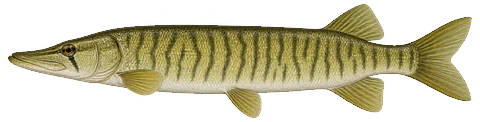
- Typical adult
- 6–10 in; occasionally 12 in
- Spawns
- Early spring, at 43–53°F, scattering eggs over plants
- Eats
- Mostly fish; also crayfish, frogs and large insects
- Needs
- Clear water with dense plants; intolerant of murky water
- Indiana record
- 13.8 oz — Coffee Creek Park Pond, Porter County, 2020
Where redfin (grass) pickerel have been recorded
52 of the 186 Indiana lakes on this site with fish records list redfin (grass) pickerel, across 12 counties. Tap a dot to open that lake’s depth map.
Recorded here Other lakes with fish records
How we know
- 52lakes where a DNR fisheries survey caught them
A lake can appear in more than one line. A lake that isn’t listed may still have them: records exist only where someone caught, netted or stocked them.
Inland lakes on this list run from 14 to 3,508 acres (median 82) and from 8 to 90 ft deep (median 44 ft).
How many turn up in DNR surveys
Indiana DNR crews survey lakes the same way everywhere: timed night electrofishing along the shore, plus gill and trap nets set overnight. The standard method makes lakes comparable. These are the DNR’s own sampling rates from its community surveys, 2008–2025 — a measure of how many fish a lake holds, not how many an angler will catch.
- Found in
- 45 of 175 lakes surveyed this way
- Typical rate
- 4.0 per hour where found
- Highest
- 18 per hour
- Method
- fish per hour of night electrofishing
“Typical” is the median across the lakes where the survey caught at least one. Nets and electrofishing catch different fish: by the other method it turned up in 14 lakes at a typical 0.25 per net lift. A single survey is a snapshot of one season.
Highest survey rates on this site
- Stone Lake, LaPorte 2017 18
- Appleman Lake, LaGrange 2012 12
- Lawrence Lake, Marshall 2017 10
- Pretty Lake, Marshall 2017 10
- Bell Lake, Steuben 2015 8.0
- Center Lake, Kosciusko 2020 8.0
- Fox Lake, Steuben 2015 8.0
- Brokesha Lake, LaGrange 2015 6.0
- Eve Lake, LaGrange 2016 6.0
- Little Cedar Lake, Whitley 2014 6.0
Fish per hour of night electrofishing, with survey years. Survey effort and season differ between lakes.
Often found with
Share of these lakes that also list each fish.
How to recognize it
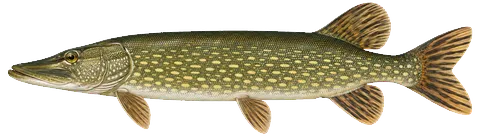
A small pike: long, tube-shaped body, a dark teardrop under the eye, and blotches or wavy bars along the sides. Unlike northern pike and muskie, the fins carry no spots. Despite the name, the grass pickerel form found in Indiana usually has yellow-green lower fins, not the red ones of the Atlantic-coast redfin.
Don’t confuse it with
Life in an Indiana lake
Redfin pickerel live in clear, heavily vegetated water: slow streams, wetlands and natural lakes. They disappear where water turns murky or streams are ditched.
In early spring they move into shallow, weedy backwaters to spawn, scattering eggs over plants with no parental care. The young eat insects until they reach about 2 inches in early June, then switch to small fish.
Source: the sources below.
Rules and eating
Check the rules before you keep fish. Each lake page shows the regulations that apply there, and the Indiana Fishing Guide is the official source. Before eating fish from a particular lake, check the Indiana Fish Consumption Advisory.
All 52 lakes with redfin (grass) pickerel
Show every lake, by county
DeKalb County 1
Kosciusko County 9
Center Lake, Dewart Lake, Hill Lake, Irish Lake, JAMES LAKE, Lake Wawasee, Sechrist Lake, Shock Lake, Spear Lake
LaGrange County 9
Adams Lake, Appleman Lake, Atwood Lake, Brokesha Lake, Eve Lake, Martin Lake, Stone Lake, Westler Lake, Witmer Lake
LaPorte County 3
Lake County 1
Marshall County 3
Newton County 1
Noble County 10
Bear Lake, Big Lake, Diamond Lake, Eagle Lake, Engle Lake, Lindsey Lake, Lower Long Lake, Pleasant Lake, Rivir Lake, Round Lake
Pike County 2
Porter County 2
Steuben County 8
Bell Lake, Big Otter Lake, Fox Lake, Hamilton Lake, Lake Arrowhead, McClish Lake, Round Lake, Silver Lake
Whitley County 3
Sources
- Indiana DNR: Fishes of Indiana list (native and introduced species)
- Ohio DNR: Grass (redfin) pickerel
- Ohio DNR: Northern pike
- USGS Nonindigenous Aquatic Species: Grass pickerel (Esox americanus vermiculatus)
- USGS Nonindigenous Aquatic Species: Redfin pickerel (Esox americanus americanus)
- West Virginia DNR: Esocid management plan (redfin vs grass pickerel)
- Indiana DNR fish surveys (Indiana Data Hub) — lake records and survey catch rates
- Indiana DNR record fish list (angler names are not reproduced here)