Mussel
Zebra Mussel
Dreissena polymorpha
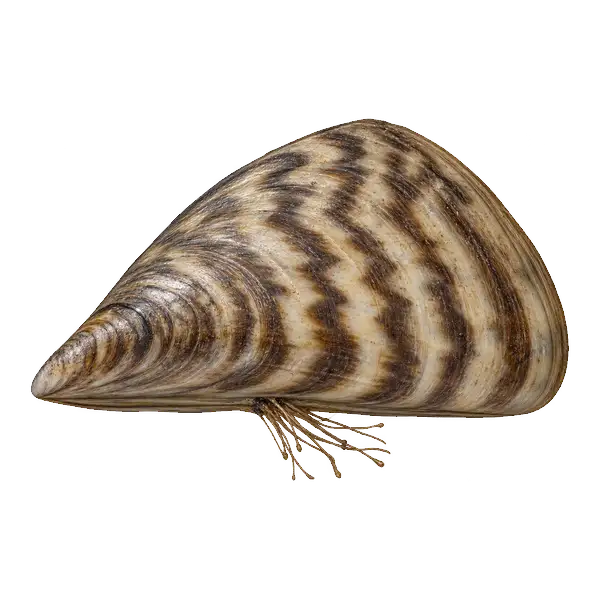
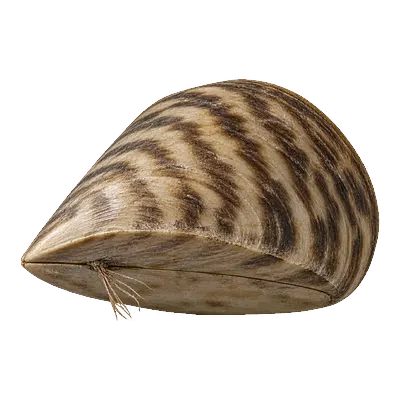
These illustrations are AI-generated, not photographs, and are not to scale. They show what to look for; they are not a substitute for an expert identification.
How to identify it
Size: About 1 inch long, often smaller.
- A D-shaped or triangular shell with a sharp ridge along one edge.
- A flat underside, so the shell sits upright if you set it down.
- Dark and light zigzag or wavy stripes. The pattern varies and can be faint.
- Fine threads that glue it to rocks, docks, boats and other shells, often in clusters.
Don’t confuse it with
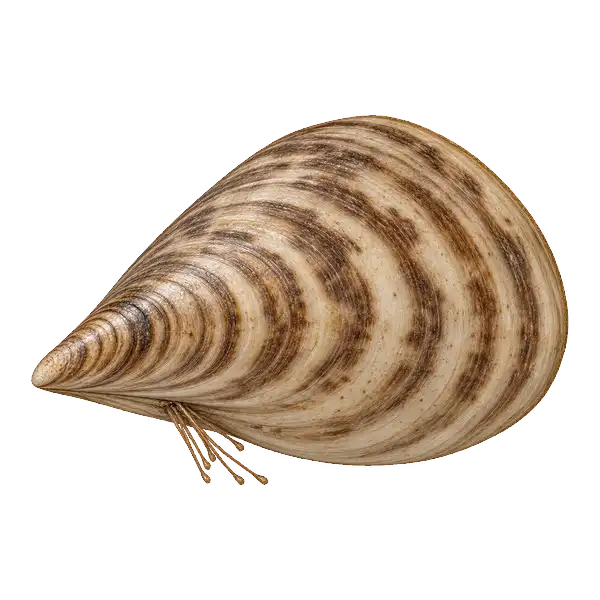
Quagga mussel, another invasive, is rounder and has no flat underside: set one on its side and it rolls over. Native mussels are much larger, have no attachment threads, and live partly buried in the lake bottom.
Where it came from
Native to the Black Sea and Caspian Sea region of eastern Europe and western Asia.
Carried to the Great Lakes in the ballast water of ocean-going ships in the 1980s. It reaches inland lakes mostly on boats, trailers and gear, and as tiny free-floating young in bilge and live-well water.
Earliest dated Indiana record: 1988, the Lake George Canal in East Chicago, Lake County. This is the oldest dated record in the USGS non-native species database, not necessarily when it first arrived.
Why it matters
Zebra mussels filter large amounts of water, removing the plankton that young fish and many native animals feed on. They coat docks, boat hulls, water intakes and native mussels, and their sharp shells cut bare feet on beaches.
Indiana law
Prohibited under Indiana's mussel rule (312 IAC 9-9-3). It is illegal to import, possess or release it into public or private waters. Taking one and killing it immediately does not break the rule. Indiana DNR’s page.
If you find it
- Don’t move it. Before leaving the water, remove all plants, mud and debris and drain all water from your boat, motor, live well, bilge and trailer. Carrying plants listed in Indiana’s Aquatic Plant Rule on vehicles, boats or trailers is illegal and can bring fines. Clean boater tips
- Never release bait or pets. Don’t dump bait, aquarium animals or water-garden plants into any lake or stream. Put unused bait in the trash.
- Report it. Take a photo, note where you saw it, and report it through EDDMapS or the GLEDN phone app, or contact Indiana DNR’s aquatic invasive species program at 317-234-3883 or ais@dnr.IN.gov. Experts there can confirm what you found.
- Ask before removing or treating. On public lakes, any control of aquatic plants — chemical, mechanical, physical or biological — needs an Indiana DNR aquatic vegetation control permit. When a permit is needed
Indiana lakes where it has been recorded
15 Indiana lakes on this site have a record of this species.
Kosciusko
Big Barbee, Dewart Lake, James Lake, Lake Wawasee, Pike Lake
LaGrange
Lake
Marshall
Noble
Steuben
Whitley
A lake that is not listed may still have it. Records exist only where someone found the species and reported it, so “not recorded” does not mean “not present.”
Lake records: Midwest Glacial Lakes Partnership Conservation Planner; underlying records from the USGS Nonindigenous Aquatic Species database.
Sources
- USGS Nonindigenous Aquatic Species: Zebra mussel fact sheet
- Indiana DNR: Aquatic invasive species, invertebrates
- Indiana DNR: Aquatic invasive species possession rules (312 IAC 9-9-3)
Earliest dated record: USGS Nonindigenous Aquatic Species database.