Shoreline and wetland plant
Purple Loosestrife
Lythrum salicaria
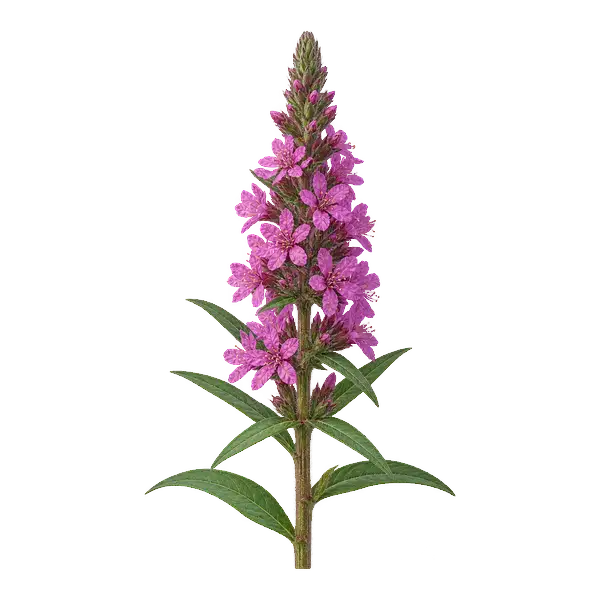

These illustrations are AI-generated, not photographs, and are not to scale. They show what to look for; they are not a substitute for an expert identification.
How to identify it
Size: Often 4 to 10 feet tall.
- Tall spikes of magenta-purple flowers in mid to late summer.
- Each flower has 5 to 7 crinkled petals.
- Lance-shaped leaves with smooth edges, attached straight to the stem in pairs or rings of three.
- A stiff, angled stem, often with four to six sides.
Don’t confuse it with
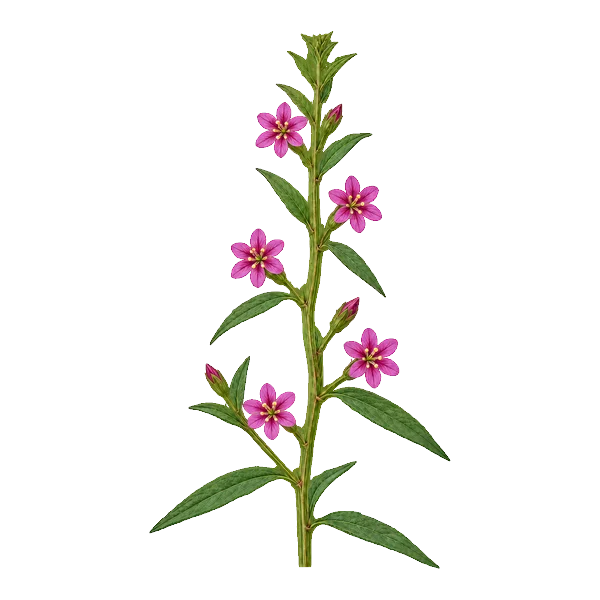
Fireweed has four petals and leaves that alternate along a round stem. Native winged loosestrife is smaller, with single flowers where the leaves meet the stem rather than a dense spike.
This is a shoreline and wetland plant. You will find it along the water's edge, not out in the lake.

Where it came from
Native to Europe and Asia.
Arrived in eastern North America in the early 1800s, probably in ships' ballast and as a garden and medicinal plant. It spreads through huge numbers of tiny seeds carried by water, wind, animals and people.
Earliest dated Indiana record: 1900, near Aetna, Lake County. This is the oldest dated record in the USGS non-native species database, not necessarily when it first arrived.
Why it matters
It forms dense stands along shores and in wetlands that push out the native plants birds, insects and other wildlife depend on.
Indiana law
Under Indiana rule 312 IAC 18-3-13, no one may sell, offer for sale, give away or otherwise distribute seeds or plants of purple loosestrife in Indiana. Indiana DNR’s page.
If you find it
- Don’t move it. Before leaving the water, remove all plants, mud and debris and drain all water from your boat, motor, live well, bilge and trailer. Carrying plants listed in Indiana’s Aquatic Plant Rule on vehicles, boats or trailers is illegal and can bring fines. Clean boater tips
- Never release bait or pets. Don’t dump bait, aquarium animals or water-garden plants into any lake or stream. Put unused bait in the trash.
- Report it. Take a photo, note where you saw it, and report it through EDDMapS or the GLEDN phone app, or contact Indiana DNR’s aquatic invasive species program at 317-234-3883 or ais@dnr.IN.gov. Experts there can confirm what you found.
- Ask before removing or treating. On public lakes, any control of aquatic plants — chemical, mechanical, physical or biological — needs an Indiana DNR aquatic vegetation control permit. When a permit is needed
Indiana lakes where it has been recorded
2 Indiana lakes on this site have a record of this species.
LaGrange
A lake that is not listed may still have it. Records exist only where someone found the species and reported it, so “not recorded” does not mean “not present.”
Lake records: Midwest Glacial Lakes Partnership Conservation Planner; underlying records from the USGS Nonindigenous Aquatic Species database.
Sources
- USGS Nonindigenous Aquatic Species: Purple loosestrife fact sheet
- Indiana Administrative Code, 312 IAC 18-3-13
- Indiana Aquatic Plant Rule sheet (lists the loosestrife rule)
Earliest dated record: USGS Nonindigenous Aquatic Species database.