Jellyfish
Freshwater Jellyfish
Craspedacusta sowerbii
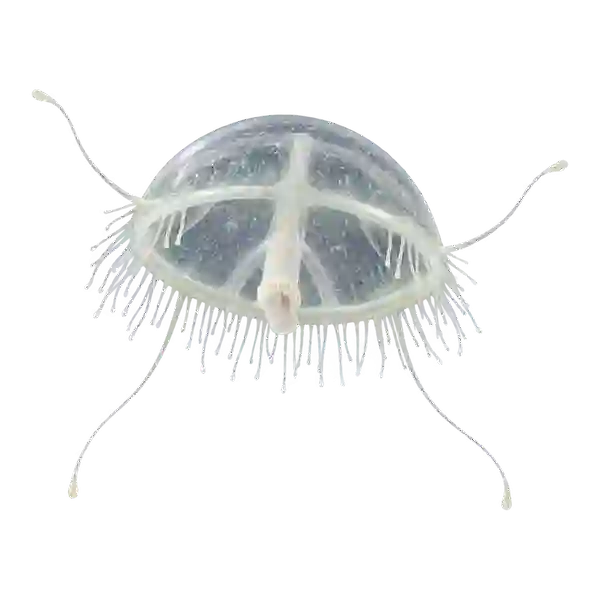
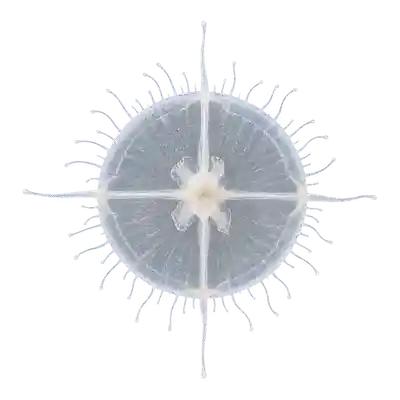
These illustrations are AI-generated, not photographs, and are not to scale. They show what to look for; they are not a substitute for an expert identification.
How to identify it
Size: About the size of a dime to a quarter: 5 to 25 millimeters (up to about 1 inch) across.
- A small, nearly clear bell with a milky white or greenish tint.
- Four canals inside the bell that form a cross.
- A feeding tube hanging down from the center.
- A fringe of many short tentacles around the edge, with four longer ones.
- Usually seen in late summer in calm, warm water, and in some years not at all.
Don’t confuse it with
It is the only freshwater jellyfish you are likely to see in Indiana, so a small jellyfish in an inland lake is almost certainly this one.
Harmless to people.
Where it came from
Native to the Yangtze River basin in China.
Found in North America since the late 1800s, probably carried with shipments of aquatic plants or fish. Its tiny bottom-dwelling stage is easy to move without anyone noticing.
Earliest dated Indiana record: 1998, a farm pond in Vevay, Switzerland County. This is the oldest dated record in the USGS non-native species database, not necessarily when it first arrived.
Why it matters
It is considered harmless to people: its stings are too weak to be felt. It eats tiny animals called zooplankton, and scientists are still studying its effect on lakes. It is included here because people often spot it and wonder what it is.
Indiana law
Not listed in Indiana's invasive species rules. The steps below still help keep it from spreading.
If you find it
- Don’t move it. Before leaving the water, remove all plants, mud and debris and drain all water from your boat, motor, live well, bilge and trailer. Carrying plants listed in Indiana’s Aquatic Plant Rule on vehicles, boats or trailers is illegal and can bring fines. Clean boater tips
- Never release bait or pets. Don’t dump bait, aquarium animals or water-garden plants into any lake or stream. Put unused bait in the trash.
- Report it. Take a photo, note where you saw it, and report it through EDDMapS or the GLEDN phone app, or contact Indiana DNR’s aquatic invasive species program at 317-234-3883 or ais@dnr.IN.gov. Experts there can confirm what you found.
- Ask before removing or treating. On public lakes, any control of aquatic plants — chemical, mechanical, physical or biological — needs an Indiana DNR aquatic vegetation control permit. When a permit is needed
Indiana lakes where it has been recorded
11 Indiana lakes on this site have a record of this species.
Brown
Dubois
Elkhart
Kosciusko
LaGrange
LaPorte
Marshall
Wabash
A lake that is not listed may still have it. Records exist only where someone found the species and reported it, so “not recorded” does not mean “not present.”
Lake records: Midwest Glacial Lakes Partnership Conservation Planner; underlying records from the USGS Nonindigenous Aquatic Species database.
Sources
Earliest dated record: USGS Nonindigenous Aquatic Species database.