Underwater plant
Eurasian Watermilfoil
Myriophyllum spicatum
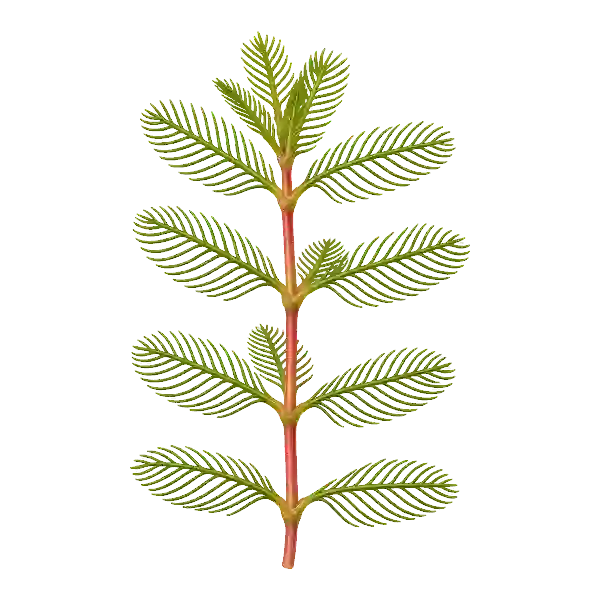
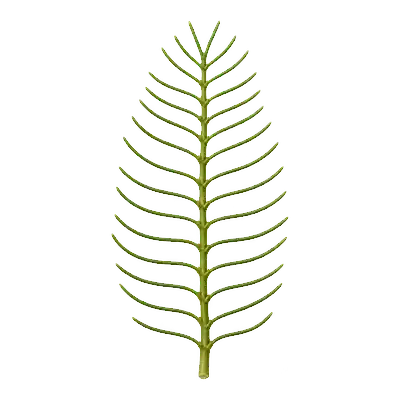
These illustrations are AI-generated, not photographs, and are not to scale. They show what to look for; they are not a substitute for an expert identification.
How to identify it
Size: Leaves about 1/2 to 2 inches long, on long stems that can reach the surface.
- Soft, feathery leaves in rings (whorls), usually four to a ring, around the stem.
- 12 or more pairs of thread-like leaflets on each leaf. Count them: this is the most useful check.
- Leaf tips that often look blunt, as if clipped off.
- Reddish stem tips, often branching near the surface.
Don’t confuse it with
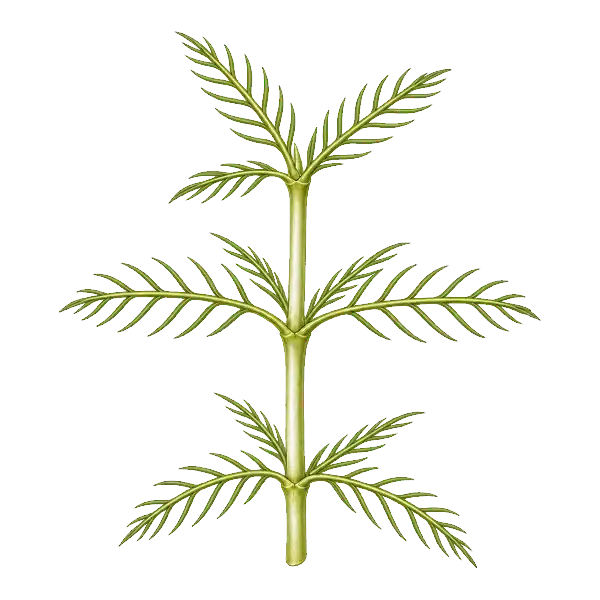
Native northern watermilfoil usually has fewer leaflet pairs, about 5 to 10, and stiffer leaves. The two can also cross, and the hybrid can be hard to tell apart without a lab test.
Where it came from
Native to Europe, Asia and northern Africa.
Established in North America by the mid-1900s. It spreads between lakes mainly as plant pieces caught on boats, trailers, motors and fishing gear. A single piece can start a new plant.
Earliest dated Indiana record: 1976, Upland (Taylor) Lake, Grant County. This is the oldest dated record in the USGS non-native species database, not necessarily when it first arrived.
Why it matters
It can form thick mats at the surface that crowd out native plants, make swimming and boating difficult, and change the habitat fish use.
Indiana law
Listed in Indiana's Aquatic Plant Rule (312 IAC 18-3-23), which makes it illegal to sell, give away, barter, exchange, distribute, transport or introduce the plant in Indiana. Fines can apply for carrying listed plants on vehicles, boats or trailers. Indiana DNR’s page.
If you find it
- Don’t move it. Before leaving the water, remove all plants, mud and debris and drain all water from your boat, motor, live well, bilge and trailer. Carrying plants listed in Indiana’s Aquatic Plant Rule on vehicles, boats or trailers is illegal and can bring fines. Clean boater tips
- Never release bait or pets. Don’t dump bait, aquarium animals or water-garden plants into any lake or stream. Put unused bait in the trash.
- Report it. Take a photo, note where you saw it, and report it through EDDMapS or the GLEDN phone app, or contact Indiana DNR’s aquatic invasive species program at 317-234-3883 or ais@dnr.IN.gov. Experts there can confirm what you found.
- Ask before removing or treating. On public lakes, any control of aquatic plants — chemical, mechanical, physical or biological — needs an Indiana DNR aquatic vegetation control permit. When a permit is needed
Indiana lakes where it has been recorded
45 Indiana lakes on this site have a record of this species.
Clark
DeKalb
Elkhart
Fulton
Jackson
Kosciusko
LaGrange
Appleman Lake, Dallas Lake, Fish Lake, Hackleburg Lake, Lake of the Woods, Martin Lake, Messick Lake, North Twin Lake, Olin Lake, Pretty Lake, Royer Lake, Wall Lake, Witmer Lake
LaPorte
Marshall
Dixon Lake, Lake Maxinkuckee, Lawrence Lake, Myers Lake, Pretty Lake
Perry
Porter
St. Joseph
Steuben
Sullivan
Whitley
A lake that is not listed may still have it. Records exist only where someone found the species and reported it, so “not recorded” does not mean “not present.”
Lake records: Midwest Glacial Lakes Partnership Conservation Planner; underlying records from the USGS Nonindigenous Aquatic Species database.
Sources
- USGS Nonindigenous Aquatic Species: Eurasian watermilfoil fact sheet
- Indiana DNR: Aquatic invasive species, plants
- Indiana Aquatic Plant Rule, 312 IAC 18-3-23: what you need to know
Earliest dated record: USGS Nonindigenous Aquatic Species database.